This article contains affiliate links.
A few minutes on foot from Hakata Station’s Chikushi exit, I knew where the shop was before I could see it. The smell got there first.
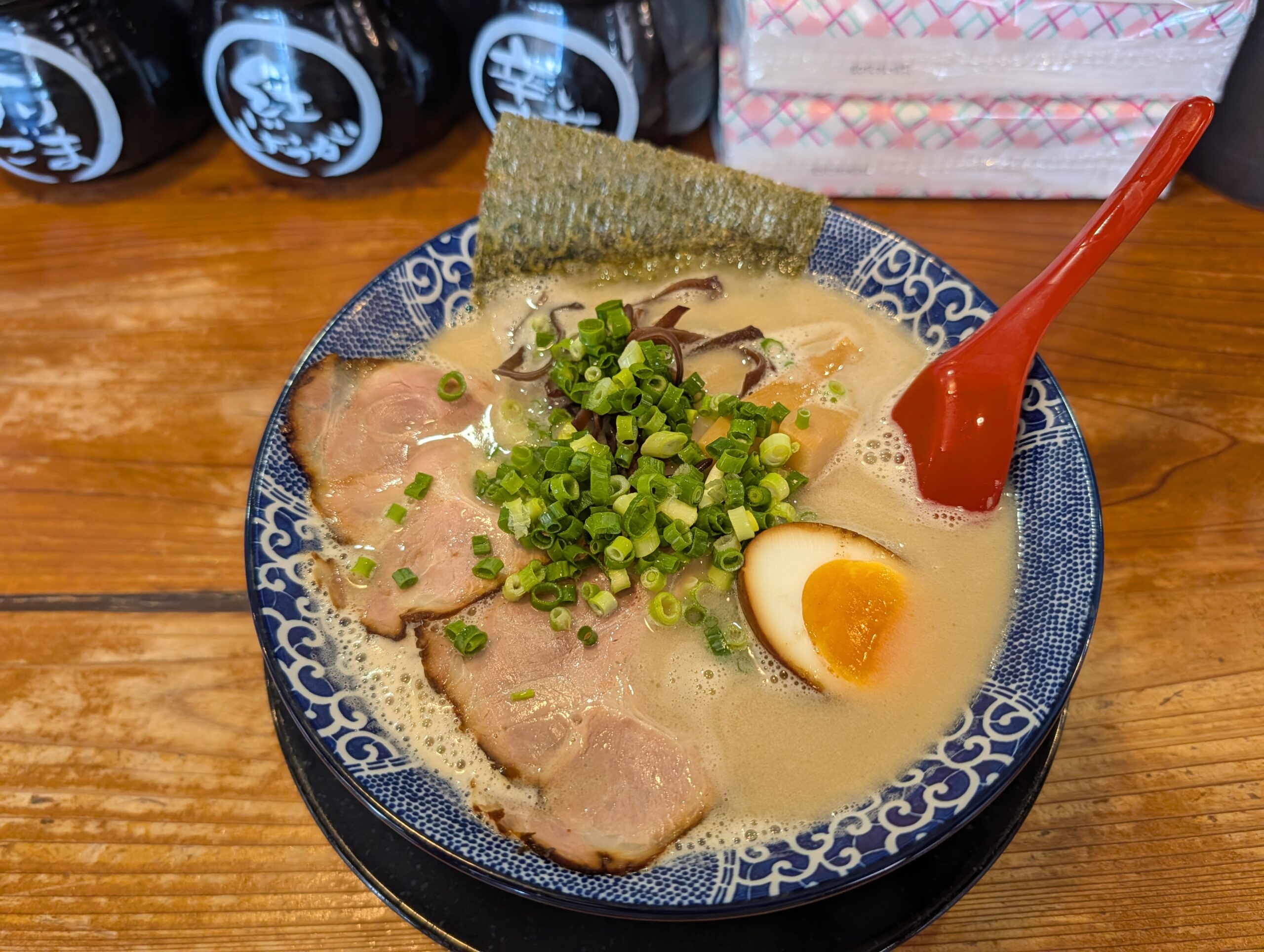
Hakata Issou. Foam-topped tonkotsu, a permanent queue, the kind of place that shows up on every Fukuoka list. We got as far as the door and one of the people I was with stopped walking. “Sorry — I can’t.” The pork bone smell coming out of the extractor fan was, for them, completely disqualifying. They waited outside.
Nobody had warned any of us that this was a thing that happens.
Fukuoka has plenty to see. Dazaifu Tenmangu, the beaches at Itoshima, the ferry over to Nokonoshima. All genuinely worth a day. But I was not in Fukuoka for any of that. I was there to eat pork bone broth from morning to night, because this city is where tonkotsu ramen was invented and where it still lives.
So this article skips the sightseeing almost entirely. What it has instead is a lot of information about smell, noodle hardness, and one conclusion that surprised me.
Fair warning about my palate: I like my broth thick and heavy. Delicate, refined food mostly goes over my head. I don’t put much stock in restaurant rankings.
The smell is the part nobody mentions
Hakata Issou
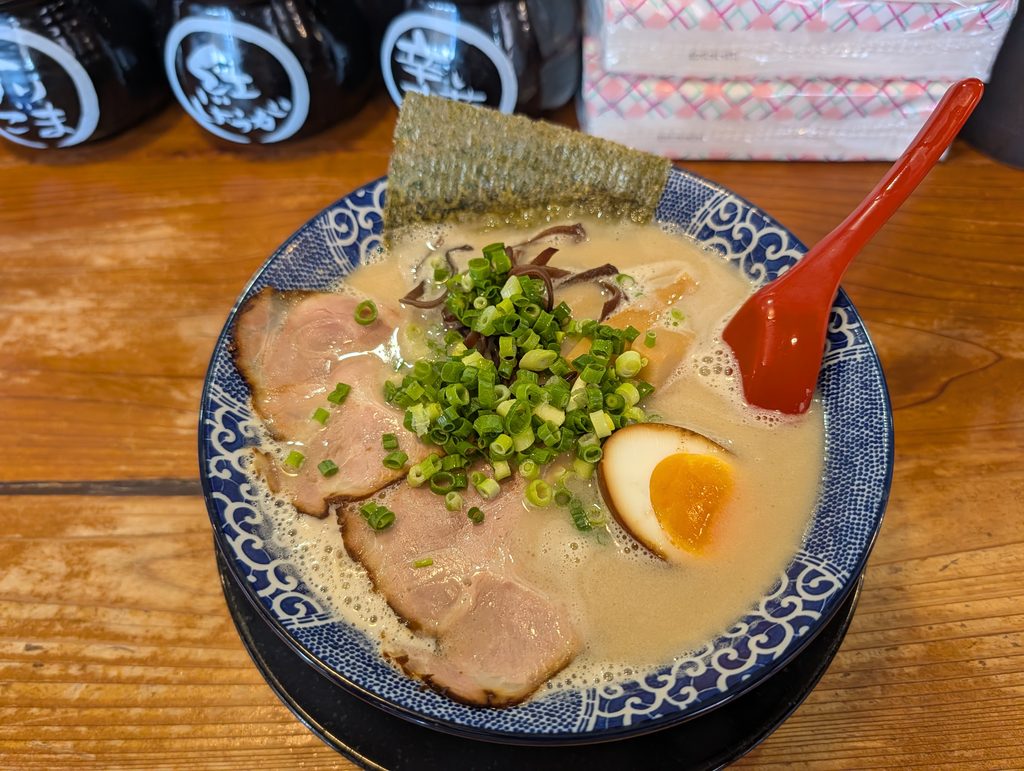
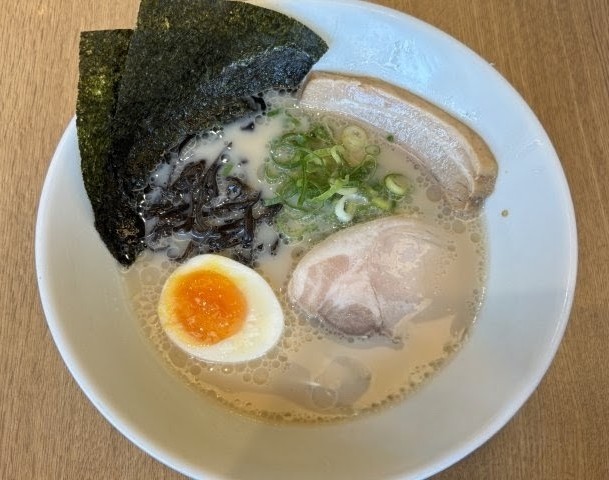
Opened in 2012 and became one of Hakata’s most-queued shops almost immediately. Three stockpots, domestic pork bones boiled until the bones themselves fall apart, and a layer of foam across the whole surface of the bowl. People call it “tonkotsu cappuccino.”
It was excellent. Genuinely thick, the kind of broth that coats your mouth. The noodles are flat and thin and carry the soup well.
It also smells enormous. The bowl looks refined — pale, foamy, almost elegant — and the smell has none of that restraint. If you have any sensitivity to pork funk at all, stand near the door for thirty seconds before you commit.
Hakata Daruma
Founded in 1963, over in the Watanabe-dori area. They use an iron kettle and a technique called yobimodoshi, where the broth is never fully emptied — new stock is added to old, continuously, for decades.
Also very smelly.
I don’t mean that as criticism. This is the smell of the thing being made properly, and it’s the clearest signal you’re eating something you can’t get at a branch overseas. Outside Kyushu, tonkotsu is almost always toned down.
Two bowls that don’t taste like Hakata
Hakata Genki Ippai!!
In Shimogofukumachi, and it’s for enthusiasts. There is no sign and no shop curtain. From the street it looks like a closed office. The way you know it’s open is a blue bucket hanging by the entrance.
It used to have a reputation for strict house rules — drink the broth first, no photographs — but those were dropped, and the atmosphere inside is relaxed now. A bowl runs about ¥1,000.
The broth is extraordinarily thick, almost viscous, and yet has no funk at all. Creamy. Honestly, the closest thing I can compare it to is corn soup with noodles in it.
I understand why people love it, and there’s nothing else like it. It just isn’t what I came to Hakata to eat.
Ramen Unari, Nakasu
Seafood tonkotsu — pork broth with fish and shellfish stock folded in. Open from 6pm to 6am, so it’s the shop that catches everyone stumbling out of the Nakasu bars. They also do a version with Genoese basil sauce, which I am not making up.
By Hakata purist standards, adding seafood is heresy. It’s also delicious. But the moment I tasted it, what came to mind was Sugakiya.
I grew up in the Tokai region, and Sugakiya is my baseline for what ramen tastes like — a cheap regional chain whose broth is pork bone with fish and kelp dashi. It’s what I ate as a child, and apparently it’s welded to my palate permanently.
Here’s the part that made it funny: there were six of us at the table, all of us from Tokai, and within about a minute someone said out loud, “does this taste like Sugakiya to you?” Every single person had been thinking it.
We flew to the birthplace of tonkotsu and were reminded of a Nagoya chain restaurant.
Unari opened a Tokyo branch in 2026, incidentally, so this particular bowl no longer requires a trip to Kyushu.
Ganso Ramen Nagahama-ya
A short walk from Unari, on the corner where the Kawabata shopping arcade meets the road toward Nakasu.
Something to know before you search for this: the naming situation here is chaotic. There’s the original Ganso Nagahamaya, then Ganso Ramen Nagahama-ya started by a former employee, and then a third shop opened by someone who split from that one, using the same name again. The signage is nearly identical. One of them sued another over it and lost; both still operate under the name.
If you look it up on Google Maps, several nearly identical results is not an error. I couldn’t tell you with confidence which one I ate at.
The ramen itself is fine — solid, standard Hakata-style tonkotsu, about ¥700 with extra noodles at ¥150. Not memorable, but this is neighborhood food, the bowl people eat at 3am without thinking about it.
Hakata Ramen ShinShin, Tenjin
Started as a yatai stall, opened as a shop in 2003, and now has several locations around the prefecture. Reviews are uniformly excellent, which is why I went.
It was good. Clean, no funk, easy to drink, and I understand completely why it’s popular.
But better than Ichiran or Ippudo? For me, no. Hold that thought.
How to order the noodles
Hakata noodles are thin and cook in seconds, which is why you get asked how firm you want them. The ladder, from softest to hardest:
| Order | Meaning |
|---|---|
| Yawa | Soft |
| Futsuu | Normal |
| Katame | Firm |
| Barikata | Very firm — the usual recommendation |
| Harigane | “Wire” |
| Konaotoshi | Barely dipped in the water |
| Yugetoshi | Passed through the steam |
| Nama | Essentially raw |
The Nagahama-lineage shops use a completely different system — just Nama, Kata, Futsuu, Yawa — and regulars combine it with fat and scallion levels into a single word, like betanama. Same city, different dialect.
Here is the practical advice, learned the hard way. I like firm noodles and used to order harigane or nama every time, and every time my stomach paid for it afterwards. The reason is straightforward: noodles that haven’t boiled long enough are still, functionally, flour. Wheat starch has to be heated to gelatinise before digestive enzymes can do much with it, so undercooked noodles arrive in your stomach in a form your body struggles with.
Barikata is where this stops happening for me. It’s also what most shops recommend by default. Ordering harder does not make you more of an expert, and there’s no prize for nama.
Kaedama, and the order of operations
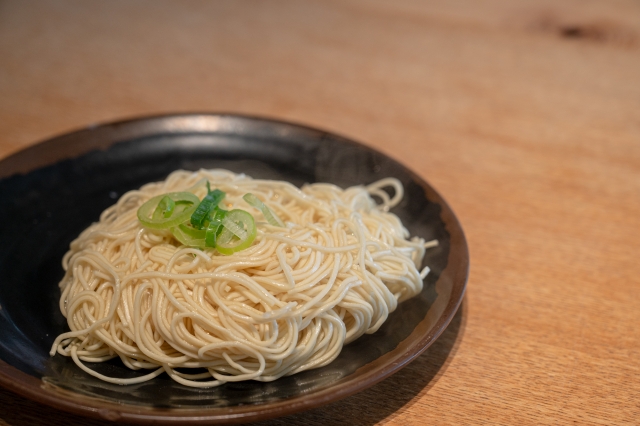
Kaedama means a second serving of noodles dropped into the broth you already have. It was invented at Ganso Nagahamaya — they made the noodles thin so fish market workers could be served fast, thin noodles go soft fast, so they cut the portion size and let people order more. Thin noodles came first; kaedama is the workaround.
How I do it:
First bowl, minimal interference. Red pickled ginger only, but a generous amount of it. I want to taste the broth and noodles as the shop made them.
No sesame. Ground sesame changes the flavour dramatically to my palate, and not in a direction I want. Plenty of people disagree.
Order the kaedama before you finish the noodles in front of you. This is the one that matters. If you wait until the bowl is empty, you sit there while they boil, the broth cools, and the momentum dies.
Don’t drink all the broth early. It’s tempting, because the first bowl is the best it will ever taste. But you need enough liquid left for a second kaedama, and possibly a third.
Once the kaedama arrives, start adjusting. Tare from the table to bring the seasoning back up, spicy mustard greens if they have them, and garlic if it’s available. Garlic makes almost anything taste better to me, so treat that as a statement about my palate rather than about the ramen.
I skipped the yatai
Nakasu’s street food stalls are the signature Fukuoka image and I walked past them without stopping.
Two reasons. They sit in the middle of an entertainment district and are priced accordingly. And I’ve spent a lot of time in Southeast Asia, where eating at a stall is just how dinner works — Bangkok, Hanoi, Taipei. The format doesn’t feel like an event to me.
The atmosphere is lovely, no argument. But if you have a limited number of bowls in you, I’d spend them indoors.
The conclusion I didn’t expect
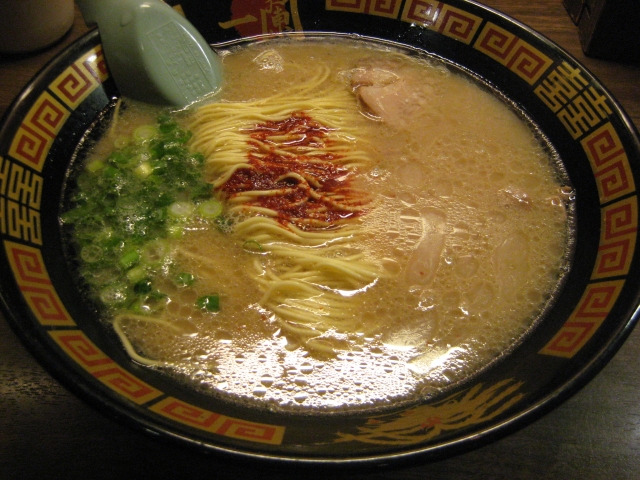
I did not visit the Ichiran or Ippudo flagship stores in Fukuoka. They taste the same everywhere, so going to the original branch seemed pointless.
And then, after all of the above, this is where I landed: the two best tonkotsu in Hakata are Ichiran and Ippudo.
The reason is the smell.
Those two are the only ones that removed the pork funk, and this isn’t my interpretation — Ichiran publishes a list of “five firsts” they claim to have originated, and the second one is tonkotsu broth without the funk. The company treats deodorising the broth as its central invention.
No funk means anyone can eat it. Nobody stops at the door. That is why these two, out of hundreds of excellent Hakata shops, are the ones that went global. The person who couldn’t walk into Issou would have finished a bowl at Ichiran without a second thought.
There’s a neat symmetry, too. All the fiddling I do at the table with tare and garlic — Ichiran handles that on a slip of paper before the bowl is made. Their order sheet lets you specify noodle firmness, broth, richness, pork, scallion, secret sauce, and garlic. That sheet is another of the five firsts. They anticipated the exact adjustment I was going to make.
I should admit my premise here. I’m assuming chain restaurants taste identical everywhere, and that isn’t universally true — Fuji Soba, for instance, has no product development department at all and lets individual branch managers trial new items, and handles complaints about inconsistency at branch level too. That chain varies deliberately. But with these two tonkotsu chains, the sameness held up every time I checked it.
The cost is money. Ippudo’s Shiromaru Motoaji runs in the ¥850 range, the simpler version around ¥790, while Nagahama-style shops start at ¥500 and top out around ¥700. Against local prices, the chains are expensive. Ichiran revised its pricing at some branches in July 2026 and prices now vary by location, so check before you go.
That gap does buy something, though. Making a bowl that no one refuses is probably the hardest version of this job.
Where I stayed, and one logistics warning
I stayed at the Hilton Fukuoka Sea Hawk, on the waterfront at Jigyohama. Every room faces the sea, the bar is genuinely nice, and the breakfast buffet does a good impression of luxury. I picked it for no particular reason.
One thing to plan around: the nearest subway stations, Tojinmachi and Nishijin, are close to a twenty-minute walk. There’s a free shuttle, but it only runs weekends and holidays, 10:00 to 19:00. If your plan involves eating ramen until 2am, the shuttle is not part of your life. Use a taxi, or the bus from Hakata Bus Terminal.
If you want to be within walking distance of the shops in this article, Nakasu, Tenjin, or right by Hakata Station will serve you far better.
Compare Fukuoka hotels on Booking.com
Before you go
eSIM. Getting data sorted before you land removes a genuine annoyance, especially since half the shops here have hours and closing days that only exist on their social media. I use Airalo.
Travel insurance. Japan is safe, but medical costs for visitors are not. World Nomads covers travellers who are already abroad, which is useful if you didn’t sort it before leaving.
Getting around. Fukuoka Airport is unusually close to the city — two subway stops from Hakata Station — so you rarely need a transfer. If you want passes or day trips, check what’s available for Fukuoka before you fly.
Browse Fukuoka passes and day trips on Klook
Come for the ramen. Bring someone with a strong stomach, or be prepared to eat alone at the door of Hakata Issou.
Leave a Reply